For decades, the Gulf region has been a land of opportunity for millions of job seekers from South Asia, Southeast Asia, and the Middle East. The promise of tax-free salaries, free accommodation, and career growth has attracted workers from India, Pakistan, Bangladesh, Nepal, Sri Lanka, the Philippines, and Egypt.
Gulf jobs refer to employment opportunities in the six member countries of the Gulf Cooperation Council (GCC): the United Arab Emirates (UAE), Saudi Arabia, Qatar, Kuwait, Bahrain, and Oman. These nations have transformed from desert economies to global hubs for oil, construction, finance, tourism, and technology.
Whether you are a fresh graduate, an experienced professional, or a semi-skilled worker, the Gulf offers something for everyone. From construction laborers earning $400 per month to IT managers earning $8,000 per month, the range of opportunities is vast.
This comprehensive guide covers everything you need to know about Gulf employment: which countries pay the most, which jobs are in demand, how to get a work visa, and how to avoid common scams. By the end, you will have a clear roadmap to starting your Gulf career.
What Are Gulf Jobs?
Gulf jobs are employment positions in the six GCC countries: UAE, Saudi Arabia, Qatar, Kuwait, Bahrain, and Oman. These jobs are typically filled by expatriate workers because the local populations are small and the economies are large.
Key characteristics of Gulf jobs:
- Tax-free salaries: No income tax on your earnings (though VAT is applied to purchases).
- Visa sponsorship: Your employer arranges your work visa and residency permit.
- Fixed-term contracts: Usually 2 years, renewable by mutual agreement.
- End-of-service benefits: A lump sum payment equal to 21 days of salary per year of service.
- Accommodation and transport: Many employers provide free housing, utility allowances, or company buses.
- Annual home leave: 21–30 days of paid vacation plus a flight ticket to your home country each year.
Gulf jobs range from unskilled labor (cleaners, helpers, loaders) to highly skilled professionals (doctors, engineers, pilots). The common factor is that almost all workers are expatriates. The local workforce (citizens) typically holds government or senior management positions.

Why People Prefer Gulf Jobs
Millions of workers choose Gulf employment every year. Here is why:
1. Tax-Free Income
In most countries, you pay 20–40% of your salary in income tax. In the Gulf, you keep everything you earn. A $2,000 monthly salary in the Gulf feels like a $3,000 salary in a taxable country.
2. Lower Cost of Living (for basic needs)
While rent in Dubai or Doha can be high, many employers provide free accommodation. Food, utilities, and transportation are often subsidized. For workers living in company-provided labor camps, monthly expenses can be as low as $100–$200.
3. Remittances to Home Country
Workers from India, Pakistan, Bangladesh, and the Philippines send billions of dollars home each year. A salary that is modest by Gulf standards can support an entire family back home.
4. Career Growth
The Gulf is building the future. Mega-projects like NEOM (Saudi Arabia), Lusail City (Qatar), and Dubai Expo legacy projects create demand for skilled workers. Experience in the Gulf is respected worldwide.
5. Safety and Stability
Despite media portrayals, the Gulf countries are among the safest in the world. Crime rates are extremely low. Political stability is high.
6. Multicultural Environment
You will work alongside people from dozens of nationalities. English is widely spoken in business. You can experience different cultures without leaving your workplace.
7. Proximity to Home
For South Asians, the Gulf is a 2–4 hour flight from home. You can visit your family for weekends during Eid holidays.
Top Gulf Countries for Employment
Each GCC country has unique characteristics. Choose based on your profession, salary expectations, and lifestyle preferences.
UAE Jobs
Capital: Abu Dhabi | Commercial hub: Dubai | Currency: Dirham (AED)
The UAE is the most popular destination for expatriates. It offers the highest standard of living, best infrastructure, and most diverse job market.
In-demand sectors:
- Tourism and hospitality (hotels, restaurants, airlines)
- Real estate and construction
- Financial services and banking
- Information technology
- Healthcare
- Logistics and shipping
Average salaries (monthly):
- Unskilled worker: $350–$500
- Skilled technician: $800–$1,500
- Mid-level professional: $2,500–$4,000
- Senior manager: $6,000–$12,000
Pros: Highest salaries, best lifestyle, easiest visa process.
Cons: Higher living costs (Dubai especially), intense competition.
Saudi Arabia Jobs
Capital: Riyadh | Currency: Riyal (SAR)
Saudi Arabia is the largest Gulf economy. It is undergoing massive transformation under Vision 2030, opening up thousands of new jobs.
In-demand sectors:
- Oil and gas (still the backbone)
- Construction (NEOM, Red Sea Project, Qiddiya)
- Healthcare (new hospitals and clinics)
- Education (international schools, universities)
- Defense and security
Average salaries (monthly):
- Unskilled worker: $300–$450
- Skilled technician: $700–$1,200
- Mid-level professional: $2,000–$3,500
- Senior manager: $5,000–$10,000
Pros: Lower living costs than UAE, high demand for engineers and healthcare workers.
Cons: Strict social norms, limited entertainment, extreme summer heat.
Qatar Jobs
Capital: Doha | Currency: Riyal (QAR)
Qatar hosted the 2022 FIFA World Cup, leading to massive infrastructure investment. Construction has slowed, but operational jobs remain.
In-demand sectors:
- Oil and gas
- Construction (completion phase)
- Hospitality and tourism
- Education (campus of international universities)
- Healthcare
Average salaries (monthly):
- Unskilled worker: $330–$500
- Skilled technician: $750–$1,300
- Mid-level professional: $2,200–$3,800
- Senior manager: $5,500–$10,000
Pros: High salaries, excellent healthcare, growing economy.
Cons: Smaller job market than UAE or Saudi, limited permanent residency options.
Kuwait Jobs
Capital: Kuwait City | Currency: Dinar (KWD) – highest value currency in the world
Kuwait has a more relaxed pace than Dubai or Doha. It is good for long-term stability.
In-demand sectors:
- Oil and petrochemicals
- Construction
- Healthcare (nurses, doctors)
- Education (teachers)
- Domestic work (housemaids, drivers)
Average salaries (monthly):
- Unskilled worker: $300–$450
- Skilled technician: $650–$1,100
- Mid-level professional: $1,800–$3,000
- Senior manager: $4,000–$8,000
Pros: High currency value, lower living costs, less competition.
Cons: Harsh summer, limited entertainment, slower visa processing.
Bahrain Jobs
Capital: Manama | Currency: Dinar (BHD)
Bahrain is the smallest GCC country. It has a more liberal culture and is a financial hub.
In-demand sectors:
- Banking and finance
- Oil (smaller scale)
- Tourism and hospitality
- Retail
- Healthcare
Average salaries (monthly):
- Unskilled worker: $300–$400
- Skilled technician: $600–$1,000
- Mid-level professional: $1,600–$2,800
- Senior manager: $4,000–$7,000
Pros: Liberal culture, easier for families, lower cost of living.
Cons: Smaller job market, lower salaries than UAE/Qatar.
Oman Jobs
Capital: Muscat | Currency: Rial (OMR)
Oman is known for its natural beauty and slower pace of life. It is good for those seeking stability over high salaries.
In-demand sectors:
- Oil and gas
- Logistics (Port of Duqm, Sohar)
- Tourism
- Fisheries and agriculture
- Construction
Average salaries (monthly):
- Unskilled worker: $280–$400
- Skilled technician: $550–$950
- Mid-level professional: $1,500–$2,500
- Senior manager: $3,500–$6,000
Pros: Beautiful environment, relaxed culture, lower living costs.
Cons: Lower salaries, slower career progression.
Most In-Demand Gulf Jobs
Here are the specific job categories with the highest number of Gulf vacancies.
| Job Category | Typical Nationalities | Education Requirement | Monthly Salary (USD) |
|---|---|---|---|
| Construction Worker | India, Pakistan, Nepal, Bangladesh | None (basic literacy) | $300–$500 |
| Driver (Light/Heavy) | India, Pakistan, Sri Lanka | Driving license (home country) | $350–$700 |
| Security Guard | India, Nepal, Philippines | None (training provided) | $300–$550 |
| Hotel Worker (Housekeeping, F&B) | Philippines, India, Nepal, Sri Lanka | High school | $350–$800 |
| Nurse | India, Philippines, Egypt | Nursing degree, license | $1,200–$2,500 |
| Engineer (Civil, Mechanical, Electrical) | India, Pakistan, Egypt, Jordan | Bachelor’s degree | $1,500–$4,000 |
| IT Professional (Developer, Support) | India, Pakistan, Egypt | Bachelor’s degree, certifications | $2,000–$5,500 |
| Teacher (International schools) | UK, US, Canada, South Africa, India | Bachelor’s + teaching license | $2,500–$5,000 |
| Sales Executive | India, Pakistan, Philippines, Egypt | High school or bachelor’s | $500–$1,800 + commission |
| Accountant | India, Pakistan, Jordan, Egypt | Bachelor’s in accounting | $1,200–$3,000 |
Construction Jobs
The Gulf is one giant construction site. Projects include skyscrapers, airports, malls, housing complexes, and roads. Construction jobs include laborers, carpenters, steel fixers, painters, masons, heavy equipment operators, site supervisors, civil engineers, and project managers.
Best countries for construction jobs: Saudi Arabia (NEOM, Red Sea), UAE (Dubai, Abu Dhabi), Qatar (post-World Cup maintenance).
Driver Jobs
Drivers are always in demand. Light drivers deliver goods or drive company staff. Heavy drivers operate trucks, buses, and heavy equipment. Many drivers also work for private families.
Requirements: Valid driving license from your home country (transferable to a Gulf license after arrival). Heavy drivers need experience with specific vehicle types.
Security Guard Jobs
Security guards protect buildings, malls, banks, hotels, and construction sites. The job requires standing for long hours, monitoring cameras, and checking IDs. Most employers provide training and uniform. No prior experience needed for entry-level roles.
Hotel Jobs
The Gulf tourism industry is booming. Hotels need housekeeping staff, waiters, front desk agents, chefs, kitchen helpers, bellboys, and guest relations officers. English speaking is mandatory. Experience in a similar role is preferred but not always required.
Hospital Jobs (Healthcare)
Hospitals hire doctors, nurses, pharmacists, lab technicians, radiographers, physiotherapists, and administrative staff. Nurses from India, the Philippines, and Egypt are in particularly high demand. You must have your credentials verified and pass a licensing exam (e.g., DHA for Dubai, MOH for Saudi).
Engineering Jobs
Civil engineers work on construction projects. Mechanical engineers work in oil/gas, manufacturing, and power plants. Electrical engineers work in utilities, construction, and telecommunications. Saudi Arabia and the UAE pay the highest engineering salaries.
IT Jobs
Software developers, network engineers, cybersecurity specialists, database administrators, and IT support staff are all in demand. Experience with cloud computing (AWS, Azure) and AI is valuable. The UAE (Dubai Internet City) and Saudi (NEOM tech hub) are the best destinations.
Teaching Jobs
International schools hire certified teachers from Western countries and also from India, Egypt, and Jordan. Subjects with highest demand: English, Mathematics, Science, and Early Childhood Education. A bachelor’s degree plus a teaching license (B.Ed., PGCE) is required.
Sales Jobs
Sales executives sell products (consumer goods, electronics, cars) or services (banking, insurance, telecom). Commission structures can double your base salary. English and Arabic are both valuable.
Accountant Jobs
Every company needs an accountant. Responsibilities include bookkeeping, payroll, VAT filing, financial reporting, and auditing. ACCA, CMA, or CPA certification significantly increases your salary.
Gulf Jobs for Freshers
Fresh graduates can find Gulf jobs in certain fields.
Fresher-friendly roles:
- Sales executive (real estate, telecom, retail)
- Customer service representative
- Administrative assistant
- Junior accountant (with internship)
- IT helpdesk (with certifications like CompTIA)
- Teacher assistant (international schools)
How freshers compete:
- Gain internships in your home country (6+ months)
- Earn professional certifications (Microsoft, Cisco, HR, accounting)
- Learn Arabic (basic conversation is a huge advantage)
- Accept a lower starting salary ($800–$1,200) to get Gulf experience
- Apply to multinational companies that have graduate trainee programs
Note: Freshers rarely get jobs in construction, driving, or security unless they have family connections. Those fields prefer experienced workers.
Gulf Jobs Without Experience
Some Gulf employment opportunities require zero prior experience. However, they are almost always low-skilled, physically demanding jobs.
Jobs you can get with NO experience:
- Construction laborer (helper)
- Cleaner (offices, malls, homes)
- Loader / unloader (warehouses, ports)
- Kitchen helper (hotels, restaurants)
- Packer (factories, warehouses)
- Farm worker (Saudi, Oman)
- Domestic helper (maid, nanny – for women)
How to find these jobs:
- Register with recruitment agencies in your home country.
- Look for “direct hire” ads (avoid agents charging high fees).
- Ask friends or relatives already working in the Gulf.
Warning: These jobs pay the lowest wages ($250–$400/month) and have the harshest working conditions. Always verify the employer before signing a contract.
Skilled vs Unskilled Gulf Jobs
| Factor | Skilled Jobs | Unskilled Jobs |
|---|---|---|
| Education | Degree, diploma, or trade certification | None or primary school |
| Examples | Engineer, nurse, accountant, IT support | Laborer, cleaner, helper, farm worker |
| Monthly salary | $1,200 – $6,000+ | $250 – $500 |
| Accommodation | Private apartment or housing allowance | Shared labor camp (8–12 per room) |
| Work hours | 8–9 hours/day | 10–12 hours/day (sometimes more) |
| Days off | 1–2 days per week (Friday off) | 0.5–1 day per week (Friday half-day) |
| Contract type | Professional (direct with company) | Often subcontracted through labor supply companies |
| Visa type | Employment visa (Residency) | Labor visa (sponsored by employer) |
| Ability to change jobs | Possible after 1–2 years (with NOC) | Difficult (sponsor must release you) |
If you have any skill (driving, typing, speaking English, basic computer use), pursue a skilled job. The quality of life is dramatically better.
Salary Expectations in Gulf Countries
Salaries vary by country, job type, and your nationality (unfortunately, discrimination exists).
Monthly salary ranges by job category (USD):
| Job Type | Entry Level | Experienced (5+ years) | Senior (10+ years) |
|---|---|---|---|
| Laborer / Cleaner | $250–$350 | $350–$500 | $500–$700 (supervisor) |
| Driver (light) | $350–$500 | $500–$700 | $700–$900 |
| Driver (heavy) | $450–$650 | $650–$900 | $900–$1,200 |
| Security guard | $300–$450 | $450–$600 | $600–$900 |
| Hotel waiter / housekeeping | $350–$550 | $550–$800 | $800–$1,200 |
| Nurse | $1,000–$1,500 | $1,500–$2,200 | $2,200–$3,000 |
| Teacher | $2,000–$3,000 | $3,000–$4,500 | $4,500–$6,000 |
| Engineer | $1,500–$2,500 | $2,500–$4,000 | $4,000–$7,000 |
| IT professional | $2,000–$3,500 | $3,500–$5,500 | $5,500–$9,000 |
| Accountant | $1,200–$2,000 | $2,000–$3,500 | $3,500–$5,000 |
| Sales executive | $500–$1,000 + commission | $1,000–$2,000 + commission | $2,000–$4,000 + commission |
| Doctor | $4,000–$6,000 | $6,000–$10,000 | $10,000–$20,000 |
Important: These are base salaries. Many employers also provide free housing, transportation, utilities, and annual flight tickets. Add 30–50% to the cash value of these benefits.
Work Visa Requirements
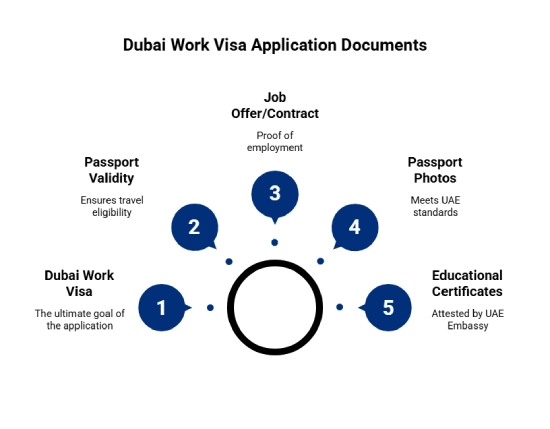
To work legally in any Gulf country, you need a work visa (also called employment visa or labor card). Your employer sponsors this visa.
General requirements:
- Valid passport (minimum 6 months validity)
- Job offer letter from a registered Gulf company
- Medical fitness certificate (tests for HIV, Hepatitis B, tuberculosis)
- Police clearance certificate (no criminal record)
- Educational certificates (attested by your home country’s Ministry of Foreign Affairs and the Gulf embassy)
- Professional license (for doctors, nurses, engineers, teachers)
Process:
- Employer applies for a work permit from the Ministry of Labor.
- You receive a work visa entry permit (stamped in your passport or as an e-visa).
- You travel to the Gulf country.
- Within 30 days of arrival, you complete medical tests, fingerprinting, and Emirates ID (or equivalent).
- Your residence visa is stamped in your passport (valid 1–3 years).
- You receive a labor card (work permit).
Cost: Usually paid by employer. Legitimate companies do not ask you to pay for your own visa. Be suspicious of any agent demanding visa fees.
How to Apply for Gulf Jobs
Follow this step-by-step process:
Step 1: Prepare your documents
- Updated CV (resume) in English (2 pages maximum)
- Copies of degrees and certificates (attested)
- Passport copy (clear photo page)
- Professional photo (white background)
Step 2: Search for jobs
Use the websites listed in the next section.
Step 3: Apply directly (preferred)
Go to company websites (e.g., Emaar, Almarai, Qatar Airways). Look for “Careers” or “Join Us” pages. Apply online. This bypasses recruitment agents.
Step 4: Register with recruitment agencies
Find agencies approved by your home country’s Bureau of Emigration. Pay only the legally permitted fee (usually $100–$200, not thousands).
Step 5: Never pay for a job offer
Scammers promise fake jobs in exchange for large fees ($1,000–$3,000). A legitimate employer pays for visa processing. If an agent demands money before you have an offer letter, walk away.
Step 6: Interview
If shortlisted, you will have a phone or video interview. Prepare answers about your experience, availability, and salary expectations.
Step 7: Receive offer letter
Read it carefully. Check: salary, accommodation provided or allowance, working hours, overtime policy, leave days, contract duration.
Step 8: Visa processing
Once you accept, the employer applies for your work visa. This takes 2–8 weeks.
Step 9: Travel
Book your flight (employer should reimburse or provide ticket). Arrive and complete medical/ID formalities.
Documents Required for Gulf Employment
Prepare these documents in advance (attestation takes time):
| Document | Attestation Required? | Where to Attest |
|---|---|---|
| Passport (minimum 1 year validity) | No | N/A |
| Passport-size photos (white background) | No | N/A |
| Educational certificates (degree, diploma) | Yes | Home country MOFA + Gulf embassy |
| Professional licenses (nursing, teaching, engineering) | Yes | Professional council + MOFA + embassy |
| Experience letters from previous employers | No (but helpful) | N/A |
| Marriage certificate (if bringing family) | Yes | Home country MOFA + embassy |
| Birth certificates (for children) | Yes | Home country MOFA + embassy |
| Police clearance certificate | Yes | Local police + MOFA + embassy |
| Medical fitness report | Yes | Approved clinic in home country or Gulf |
Attestation process (for degrees):
- Notary public (your country)
- Ministry of Foreign Affairs (your country)
- Embassy of the Gulf country (in your country)
- Ministry of Foreign Affairs (Gulf country, after arrival)
This takes 2–4 weeks. Start early.
Recruitment Agencies and Their Role
Recruitment agencies connect workers with Gulf employers. Some are ethical; many are not.
Ethical agencies:
- Registered with your home government.
- Charge only the legal maximum fee (e.g., Pakistan allows PKR 30,000 ~ $100).
- Provide a written contract before you pay.
- Have a physical office you can visit.
Unethical agencies (scammers):
- Charge thousands of dollars for “guaranteed jobs.”
- Demand payment before you receive an offer letter.
- Promises jobs in countries where you need no visa (false).
- Have no physical office or fake address.
- Pressure you to pay immediately (limited time “offer”).
How to verify an agency:
- Check your government’s list of approved recruiting agencies (e.g., Pakistan’s BE&OE, India’s eMigrate).
- Search online for ” [Agency name] scam complaints.”
- Ask for references of workers they previously placed.
Best practice: Apply directly to companies. Use agencies only as a last resort.
Gulf Job Interview Tips
Interviews for Gulf jobs are usually conducted via phone, Zoom, or WhatsApp video.
Preparation:
- Research the company (size, projects, locations).
- Know the job description (print it out).
- Prepare answers to common questions (see below).
- Test your internet connection and camera.
- Dress professionally (shirt/tie for men, business attire for women).
- Choose a quiet, well-lit room.
Common interview questions:
- “Tell us about yourself.”
- “Why do you want to work in [country]?”
- “How many years of experience do you have in [specific skill]?”
- “What is your current salary and expected salary in [currency]?”
- “When can you join?”
- “Are you willing to work overtime or weekends?”
- “Do you have a valid passport?”
- “Have you worked abroad before?”
- “How do you handle stress or long working hours?”
- “Do you have any questions for us?”
Questions YOU should ask:
- “Is accommodation provided or is there an allowance?”
- “How many days of annual leave per year?”
- “Do you provide a flight ticket home every year?”
- “What is the probation period?”
- “Does the contract include medical insurance?”
After the interview:
- Send a thank-you email within 24 hours.
- If you do not hear back in 2 weeks, send a polite follow-up.
- Continue applying elsewhere. Do not wait.
Employee Benefits in Gulf Countries
Beyond salary, Gulf employers typically provide these benefits:
- Accommodation: Either a company apartment/room or a housing allowance (usually 20–40% of salary).
- Transport: Company bus from accommodation to worksite, or transport allowance.
- Medical insurance: Basic coverage for you (sometimes family too).
- Annual leave: 21–30 calendar days per year (paid).
- Public holidays: 10–15 days per year (Eid, National Day, etc.).
- Flight ticket home: One economy ticket per year (sometimes for family as well).
- End-of-service benefit: 21 days of salary for each year of service (for first 5 years), then 30 days thereafter.
- Overtime pay: 1.25x to 1.5x hourly rate (for hourly workers).
- Free uniforms: For security, hotel, construction, driving jobs.
- Meals: For hotel, restaurant, and labor camp workers.
Family benefits (for senior roles):
- Sponsorship for spouse and children.
- Schooling allowance for children ($3,000–$10,000 per year per child).
- Family health insurance.
- Family flight tickets.
Accommodation and Living Costs
Your cost of living depends heavily on whether your employer provides housing.
If employer provides accommodation:
- Labor camps (unskilled): Shared room (8–12 people), shared bathroom. Cost to you: $0 or $20–$50 deduction from salary.
- Company apartments (skilled): Private room or shared apartment. Cost to you: $0 or $100–$300 deduction.
- Family housing (senior): Villa or 2–3 bedroom apartment. Cost to you: $0 or allowance covers it.
If you pay your own rent (less common for unskilled workers):
| City | Studio / 1-Bed (monthly) | Shared Room (monthly) |
|---|---|---|
| Dubai (UAE) | $800–$1,500 | $400–$700 |
| Riyadh (Saudi) | $400–$800 | $200–$400 |
| Doha (Qatar) | $700–$1,200 | $300–$600 |
| Kuwait City | $600–$1,000 | $250–$500 |
| Manama (Bahrain) | $500–$900 | $200–$400 |
| Muscat (Oman) | $400–$700 | $150–$300 |
Other monthly expenses (if not provided):
- Food: $100–$300 (cooking at home) to $400–$800 (eating out).
- Utilities (electricity, water, internet): $100–$250.
- Transportation: $50–$150 (bus/metro) or $300–$600 (car rental).
- Mobile phone: $20–$50.
- Entertainment: $50–$200.
Savings potential: A single worker in a labor camp can save 70–80% of salary. A professional paying their own rent in Dubai might save 20–40%.
Common Mistakes Job Seekers Should Avoid
1. Paying large fees to agents
Never pay $1,000+ for a “guaranteed” job. Legitimate employers cover visa costs.
2. Signing a contract without reading it
Get a copy in English (or a language you understand). Check salary, hours, leave, and termination terms.
3. Accepting a visa type that does not allow work
A “tourist visa” or “visit visa” does not permit employment. You must have a work visa before starting.
4. Believing promises of free tickets and bonuses
If it is not written in the contract, it does not exist. Get everything in writing.
5. Not attesting documents in advance
Attestation takes weeks. Do it before you have a job offer, or you will delay your start date.
6. Ignoring the summer heat
The Gulf summer (May–September) has 45–50°C (113–122°F) temperatures. If you work outdoors, understand the conditions.
7. Overstaying your visa
If your visit visa expires or you leave your job without canceling your work visa, you face fines ($25–$50 per day) and possible deportation.
8. Sharing a passport with your employer
Your employer may legally hold your passport in some Gulf countries (for “safe keeping”). However, they cannot refuse to return it when you need it (travel, medical). Insist on keeping your passport.
9. Not joining a union or support group
For low-wage workers, joining a community group (WhatsApp, Facebook) helps you know your rights and find help if problems arise.
10. Quitting without another job lined up
If you resign, your employer cancels your visa. You have 1–3 months to find a new sponsor or leave the country. Have a backup plan.
Gulf Jobs for Pakistanis
Pakistanis are the second-largest expatriate community in the Gulf (after Indians). Millions of Pakistanis work in Saudi Arabia, UAE, Qatar, Kuwait, Oman, and Bahrain.
Popular jobs for Pakistanis:
- Construction and civil engineering
- Driving (heavy and light)
- Security
- Hospitality (hotels, restaurants)
- Retail sales
- Mechanics and technicians
- IT and software development
- Healthcare (doctors, nurses)
Average salaries for Pakistanis (USD/month):
- Laborer: $300–$450
- Driver: $400–$700
- Technician: $600–$1,200
- Accountant: $1,000–$2,000
- Engineer: $1,500–$3,500
- IT professional: $1,800–$4,000
- Doctor: $4,000–$8,000
Recruitment process for Pakistanis:
- Register with Pakistan Overseas Employment Promoters (OEPs) – approved list available on BE&OE website.
- Attest degrees from HEC, then MOFA, then GCC embassy.
- Obtain police clearance certificate from local police + MOFA.
- Medical exam at approved center (ICRC, IOM, or authorized clinics).
- Work visa sponsored by employer.
- Travel from major airports (Islamabad, Lahore, Karachi).
Pakistani diaspora support:
- Pakistan Embassy in each Gulf country provides consular services.
- Overseas Pakistanis Foundation (OPF) offers legal aid and repatriation help.
Gulf Jobs for Indians, Bangladeshis, and Nepalis
Gulf Jobs for Indians
Indians form the largest expatriate group in the Gulf (over 8 million). Kerala, Tamil Nadu, Uttar Pradesh, and Bihar are major source states.
Key resources:
- eMigrate system (mandatory for certain job categories).
- Indian embassies in Gulf countries offer worker support.
- Pravasi Bharatiya Bhavan (Delhi) for complaints.
Average salaries for Indians (USD/month):
- Construction worker: $300–$500
- Nurse: $1,200–$2,200
- Engineer: $1,500–$4,000
- IT professional: $2,000–$5,500
Gulf Jobs for Bangladeshis
Bangladesh has over 2 million workers in the Gulf, primarily in Saudi Arabia, UAE, Qatar, and Oman.
Key resources:
- BMET (Bureau of Manpower, Employment and Training) registration required.
- Licensed recruiting agencies only (list on BMET website).
- Wage earners’ welfare board provides legal aid.
Popular jobs: Construction, agriculture, domestic work, security, driving.
Gulf Jobs for Nepalis
Nepal sends around 500,000 workers to the Gulf, mainly to UAE, Saudi Arabia, Qatar, and Kuwait.
Key resources:
- Department of Foreign Employment (DOFE) registration.
- Approved recruiting agencies list.
- Nepal embassy in each Gulf country.
Popular jobs: Security guard, construction laborer, hotel worker, driver, factory worker.
Advice for all South Asians: Always use government-approved recruitment channels. Avoid illegal agents. Keep copies of your contract, passport, and visa. Register with your embassy upon arrival.
Visa Sponsorship Jobs in the Gulf
Almost all Gulf jobs require visa sponsorship because individual workers cannot apply for work visas directly. The employer applies for your permit.
What sponsorship means:
- Your employer is legally responsible for you while you are in the country.
- Your visa is tied to that employer.
- You cannot work for another company without your sponsor’s permission (NOC – No Objection Certificate).
- If you resign or are fired, your sponsor cancels your visa, and you must leave within 1–3 months.
Kafala system (sponsorship system):
This is the legal framework in most Gulf countries. Reforms have improved worker mobility, but the sponsor still holds significant power.
Recent reforms (positive changes):
- UAE (2022): Workers can change jobs without NOC after 6 months (with conditions).
- Saudi Arabia (2021): Workers can leave the country without employer permission after 1 year.
- Qatar (2020): Abolished exit permit requirement for most workers.
How to find visa sponsorship jobs:
- Apply directly to companies (they will sponsor you).
- Use job portals with “Visa Sponsorship” filter.
- Work through licensed recruitment agencies (they coordinate with sponsors).
Red flag: Any employer offering a “free visa” but expecting you to find your own work is likely illegal. Legitimate sponsors arrange everything.

Future Job Opportunities in Gulf Countries
The Gulf job market is evolving. Here are future trends:
1. Saudi Arabia’s Vision 2030
NEOM (smart city), Red Sea Project (luxury tourism), Qiddiya (entertainment city), and dozens of giga-projects will create millions of jobs over the next decade.
In-demand jobs: Construction managers, architects, engineers, IT specialists, tourism professionals, healthcare workers.
2. UAE’s shift to knowledge economy
Dubai and Abu Dhabi are moving beyond oil into AI, blockchain, renewable energy, and space technology.
In-demand jobs: Data scientists, AI engineers, cybersecurity experts, renewable energy technicians, logistics specialists.
3. Qatar’s post-World Cup operational phase
New hotels, stadiums, and infrastructure need maintenance and operations staff.
In-demand jobs: Facility managers, hospitality supervisors, event coordinators, maintenance technicians.
4. Kuwait and Oman’s downstream industries
Petrochemicals, refining, and logistics are growing.
In-demand jobs: Chemical engineers, safety officers, logistics coordinators.
5. Green energy transition
Solar projects (Mohammed bin Rashid Al Maktoum Solar Park in Dubai, Sudair Solar Plant in Saudi) are creating jobs.
In-demand jobs: Solar technicians, electrical engineers, environmental scientists.
Jobs that will decline: Traditional construction labor (as automation increases). Low-skill roles will face wage pressure.
Preparation: Upskill in digital tools, automation, and English communication. A worker who can operate a drone or a laser level earns twice as much as a general laborer.
Frequently Asked Questions (FAQ)
1. Which Gulf country pays the highest salaries?
The UAE (especially Dubai and Abu Dhabi) and Qatar generally pay the highest salaries for professionals. Saudi Arabia pays well for oil and gas engineers. For low-skilled workers, salaries are similar across all Gulf countries ($300–$500/month).
2. Can I bring my family to the Gulf?
Yes, but only if your salary meets a minimum threshold (varies by country: UAE requires ~$1,600/month; Saudi requires ~$1,800/month). Your employer must sponsor your family. Unskilled workers rarely meet these thresholds.
3. Is Gulf experience recognized internationally?
Yes. Experience with large Gulf companies (e.g., Saudi Aramco, Emirates, QatarEnergy) is highly respected worldwide. Even smaller companies provide valuable exposure to large-scale projects.
4. What happens if I lose my job in the Gulf?
Your employer cancels your work visa. You have a grace period (usually 1–3 months) to find a new sponsor or leave the country. You cannot legally work during the grace period unless you transfer your visa.
5. Can women work in Gulf countries?
Yes. Women work in all sectors: healthcare, education, banking, IT, sales, and hospitality. Saudi Arabia has recently opened many roles to women