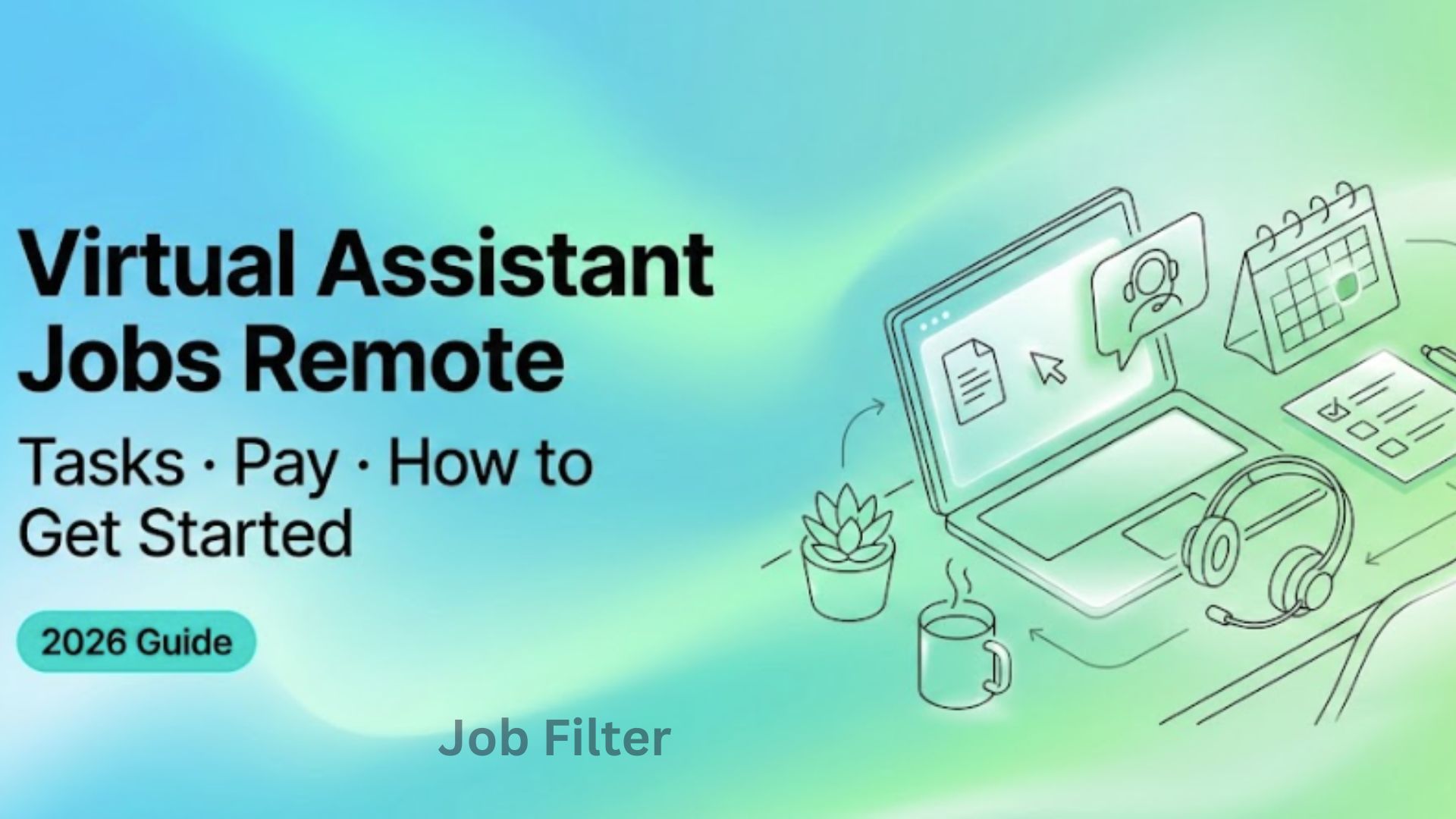
The way the world works has changed forever. Five years ago, working from home was a luxury. Today, it is the new normal. If you are tired of long commutes, strict dress codes, or office politics, there is a career path that offers freedom, flexibility, and real income. That path is becoming a Virtual Assistant.
A Virtual Assistant (VA) is a remote professional who provides administrative, technical, or creative support to businesses and entrepreneurs from a home office. You do not need a college degree. You do not need years of experience. You just need a computer, an internet connection, and the willingness to learn.
Virtual Assistant Jobs are exploding in 2026. Small businesses, online coaches, e-commerce stores, and busy executives are all hiring VAs to handle their daily tasks. The global remote work market is now worth over $4 trillion, and the demand for skilled VAs has never been higher.
In this comprehensive guide, we will cover everything you need to know about becoming a Virtual Assistant. We will explore the skills required, the tools you need, where to find jobs, and how much you can earn. Whether you are a student, a stay-at-home parent, or a fresh graduate, this guide will show you how to start your remote career today.
What Is a Virtual Assistant (VA)?
A Virtual Assistant (VA) is a self-employed or contracted professional who provides services to clients remotely. Unlike a traditional office assistant, a VA works from their own location—usually their home—and communicates with clients via email, chat, or video calls.
The term “virtual” means the assistant is not physically present. The term “assistant” means they help the client complete tasks, manage time, or improve efficiency.
VAs can work for multiple clients at once or focus on a single long-term client. Some VAs specialize in one area, such as social media or bookkeeping, while others offer general administrative support.
The rise of digital tools like Google Workspace, Slack, Zoom, and project management software has made remote assistance seamless. A VA in India can manage the calendar of a CEO in New York just as easily as an assistant sitting in the next room.
Key characteristics of a Virtual Assistant:
- Works remotely (from home, coworking space, or anywhere with internet).
- Usually paid hourly, per project, or on a monthly retainer.
- Uses their own computer and software.
- Manages their own schedule and taxes (if freelancing).
- Typically communicates asynchronously or during overlapping working hours.
What Does a Virtual Assistant Do?
A Virtual Assistant can perform almost any task that does not require physical presence. The specific duties depend on the client’s industry, size, and needs. Below are the most common responsibilities:
Email Management
- Sorting, labeling, and prioritizing incoming emails.
- Drafting and sending replies on behalf of the client.
- Unsubscribing from spam and organizing folders.
- Flagging urgent messages for the client’s attention.
Calendar Scheduling
- Scheduling meetings across different time zones.
- Sending calendar invites and reminders.
- Blocking focus time and personal appointments.
- Rescheduling canceled or postponed meetings.
Customer Support
- Responding to customer inquiries via email, chat, or social media.
- Processing refunds, returns, or exchanges.
- Troubleshooting common product issues.
- Escalating complex problems to the client or manager.
Data Entry
- Copying data from PDFs or images into spreadsheets.
- Cleaning and deduplicating databases.
- Updating CRM (Customer Relationship Management) systems.
- Creating product listings for e-commerce stores.
Social Media Management
- Scheduling posts using tools like Buffer or Later.
- Responding to comments and direct messages.
- Creating basic graphics using Canva.
- Researching hashtags and trending topics.
Content Creation
- Writing blog posts, newsletters, or social media captions.
- Editing videos using simple tools (CapCut, Descript).
- Creating PowerPoint or Google Slides presentations.
- Transcribing podcasts or videos into text.
Research Tasks
- Finding contact information for potential partners or influencers.
- Researching competitors’ pricing or strategies.
- Gathering data for blog posts or reports.
- Finding the best prices for travel or supplies.
Bookkeeping
- Logging income and expenses in spreadsheets or QuickBooks.
- Sending invoices to clients.
- Tracking unpaid bills and following up.
- Preparing simple profit and loss statements.
Travel Arrangements
- Booking flights, hotels, and rental cars.
- Creating detailed travel itineraries.
- Checking visa requirements and travel restrictions.
- Managing cancellations and rebookings.
Administrative Support
- Uploading files to Google Drive or Dropbox.
- Creating and organizing folders.
- Transcribing handwritten notes or audio recordings.
- Ordering supplies (if the client has a physical product).
Why Virtual Assistant Jobs Are Growing
Several trends have converged to create a boom in Virtual Assistant Jobs.
1. The Remote Work Revolution
After the COVID-19 pandemic, millions of companies realized that remote work is productive and cost-effective. Many have permanently shifted to hybrid or fully remote models. These companies need support staff who are also remote.
2. Rise of Solopreneurs and Small Businesses
Individuals are starting online businesses at record rates. A single entrepreneur selling on Etsy, Shopify, or Amazon often cannot handle emails, social media, order fulfillment, and customer service alone. They hire VAs to take over specific tasks.
3. Cost Savings for Businesses
Hiring a full-time, in-office administrative assistant costs a company $40,000–$60,000 per year plus benefits, office space, and equipment. Hiring a VA from a lower-cost region or on a part-time basis costs a fraction of that.
4. Improved Technology
Cloud-based tools, video conferencing, project management software, and AI assistants have made remote collaboration seamless. A client can assign a task via Trello, and the VA can complete it within hours without ever meeting face-to-face.
5. Generational Shift in Work Preferences
Gen Z and Millennials prioritize flexibility, autonomy, and work-life balance over job security. Virtual assisting offers exactly that. Many workers actively choose freelance VA work over traditional 9-to-5 jobs.
Benefits of Working as a Virtual Assistant
Becoming a Virtual Assistant comes with numerous advantages that traditional office jobs cannot match.
Work From Home
You eliminate commuting, save money on gas or public transport, and work in comfortable clothes. You can also work from coffee shops, libraries, or while traveling.
Flexible Schedule
Many VA jobs are asynchronous. You do not need to work 9-to-5. You can work early mornings, late nights, or split your day into blocks. As long as tasks are completed by deadlines, clients rarely care when you work.
Global Clients
Your location does not limit you. You can work for a client in London, a startup in Singapore, or a coach in California. Time zones become an advantage, not a barrier.
Low Startup Costs
You do not need a degree, certification, or expensive equipment. A basic laptop ($300–$500), a stable internet connection ($20–$50/month), and free software (Google Docs, Trello, Zoom) are enough to start.
Multiple Income Opportunities
You can work for multiple clients simultaneously, diversifying your income. If one client pauses work, you still have others. You can also raise your rates as you gain experience.
Better Work-Life Balance
You control your workload. You can work 10 hours a week for side income or 40 hours a week as a full-time career. You can take time off without asking permission (though you should notify clients in advance).
No Office Politics
You do not deal with toxic coworkers, micromanaging bosses, or pointless meetings. Your relationship with clients is purely professional and task-focused.

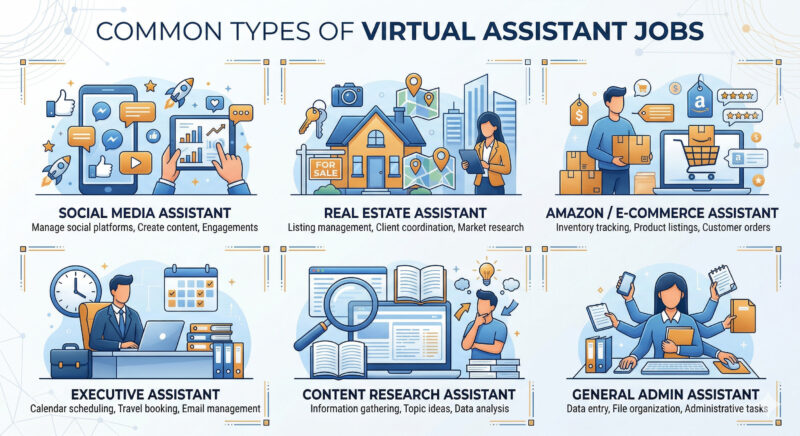
Types of Virtual Assistant Jobs
Not all Virtual Assistant jobs are the same. Below are the most common specializations.
| Type | Primary Tasks | Average Hourly Rate |
|---|---|---|
| Administrative VA | Email, calendar, data entry, file organization | $10–$25 |
| Executive VA | High-level support for C-suite executives; complex scheduling, travel, confidential tasks | $25–$50 |
| Customer Service VA | Answering chats/emails, processing refunds, managing tickets | $8–$20 |
| Social Media VA | Scheduling posts, engaging with followers, basic graphic design | $12–$30 |
| Real Estate VA | Listing properties, scheduling showings, CRM management | $15–$35 |
| E-commerce VA | Product listing, inventory tracking, order fulfillment | $10–$25 |
| Data Entry VA | Copy-pasting, database cleaning, spreadsheet management | $5–$15 |
| Content Writing VA | Blog posts, newsletters, social media captions | $15–$40 |
| Bookkeeping VA | Invoicing, expense tracking, simple accounting | $20–$45 |
| Technical VA | Basic website updates, email funnel setup, software integration | $25–$60 |
Skills Required for Virtual Assistant Jobs
You do not need a degree, but you do need specific skills. Focus on developing these core competencies.
Communication Skills
You must write clear, professional emails. You must be able to ask clarifying questions without being annoying. You must summarize complex information concisely.
Time Management
You will juggle multiple tasks for multiple clients. Use tools like Toggl, Clockify, or a simple planner to track your hours and meet deadlines.
Organization Skills
Your digital files must be logical. Your email inbox must be under control. Your client’s passwords and logins must be stored securely (use a password manager like Bitwarden).
Microsoft Office
Word (document formatting), Excel (basic formulas, filters, pivot tables), PowerPoint (presentations), and Outlook (email/calendar).
Google Workspace
Gmail (labels, filters), Google Drive (folder structure), Google Docs (collaborative writing), Google Sheets (spreadsheets), Google Calendar (scheduling).
Social Media Management
Understanding how Facebook, Instagram, LinkedIn, Twitter (X), and TikTok work. Knowing how to schedule posts using third-party tools.
Customer Service
Patience, empathy, and problem-solving. Knowing how to say “I don’t know, but I will find out” professionally.
Problem Solving
Clients hire VAs to solve problems, not create more. If you do not know how to do something, Google it, watch a YouTube tutorial, or ask the client for guidance.
Attention to Detail
A misplaced decimal in a spreadsheet, a typo in an email, or a double-booked calendar slot can cost a client money. Double-check your work.
Virtual Assistant Jobs for Beginners
If you have never worked as a VA before, start with these entry-level roles. They require minimal experience and have lower competition.
- Data Entry VA: Simple copy-paste tasks. Look for jobs titled “Copy data from PDF to Excel.”
- Email Management VA: Help clients sort and label emails. No specialized knowledge needed.
- Transcription VA: Convert audio or video files into text. Good typing speed required (40+ WPM).
- Social Media Comment Responder: Reply to comments on Facebook or Instagram using templated responses.
- Virtual Receptionist: Answer calls or chats and forward them to the client.
Where to find beginner VA jobs:
- Upwork (filter by “Entry Level”)
- Reddit (r/slavelabour or r/forhire)
- OnlineJobs.ph (many Filipino VAs start here)
- Freelancer.com (beginner contests)
Virtual Assistant Jobs Without Experience
Yes, you can get Virtual Assistant Jobs Without Experience. Here is how.
What counts as “experience” to a client?
- Using email (you have done this).
- Using Google Docs (you have done this).
- Using social media (you have done this).
- Typing (you are doing this right now).
How to get your first job with zero experience:
Step 1: Create a simple portfolio. Do not wait for a client. Create samples yourself.
- Example: Write a sample email reply to a customer complaint.
- Example: Create a sample weekly calendar for a fake CEO.
- Example: Organize a fake Google Drive folder and take a screenshot.
Step 2: Offer to work for free or very low cost for your first 1–2 clients. This builds testimonials and case studies. You can charge $5/hour for the first 10 hours.
Step 3: Apply only to jobs that explicitly say “No experience needed” or “Entry level.” Do not waste time on senior roles.
Step 4: Highlight “transferable skills.” Did you organize a charity event at school? That is project management. Did you manage the family budget? That is bookkeeping.
Step 5: Create a simple one-page resume (use Canva templates). List your typing speed, software familiarity, and availability.
Remote Jobs for Students
Students are ideal candidates for many remote jobs. You are tech-savvy, have flexible hours (evenings, weekends, between classes), and need income without leaving campus.
Best remote jobs for students:
| Job Type | Weekly Hours | Pay Range | Difficulty |
|---|---|---|---|
| Social Media Scheduler | 5–10 | $50–$150 | Low |
| Data Entry Clerk | 10–20 | $100–$300 | Low |
| Online Tutor (English, Math) | 5–15 | $100–$450 | Medium |
| Transcriptionist | 10–20 | $80–$250 | Medium |
| Virtual Research Assistant | 5–10 | $75–$200 | Low |
| Chat Support Agent | 10–25 | $150–$500 | Low |
| Video Subtitler | 5–15 | $60–$200 | Low |
Tips for students:
- Be upfront about your class schedule. Clients appreciate honesty.
- Use university resources (free software, library Wi-Fi, career center).
- Do not take more than 15 hours per week if you are a full-time student.
- Look for “asynchronous” jobs where you do not need to be online at specific times.
Work From Home Jobs for Fresh Graduates
Fresh graduates face a tough job market. Remote VA work is an excellent alternative to unpaid internships or low-paying entry-level jobs.
Why fresh graduates make good VAs:
- You have recent experience writing papers (content creation).
- You have used collaboration tools (Google Docs, Zoom for online classes).
- You are comfortable learning new software quickly.
- You are hungry for experience and willing to work hard.
Steps for fresh graduates:
- Identify your degree’s transferable skills.
- English major → Content writing, proofreading, email management.
- Business major → Administrative support, bookkeeping, project coordination.
- IT major → Technical support, website maintenance, software training.
- Communications major → Social media management, customer support.
- Create a LinkedIn profile. List your degree, any internships, and a clear headline: “Recent Graduate | Aspiring Virtual Assistant”.
- Take free online courses. Google offers free certificates in Project Management, Data Analytics, and IT Support. Add these to your resume.
- Apply to “Remote Entry Level” jobs on Indeed and LinkedIn. Do not filter by “no experience.” Instead, filter by “entry level.”
- Consider internships that pay. Some companies offer paid remote internships specifically for recent graduates. Use internships.com or LinkedIn’s internship search.
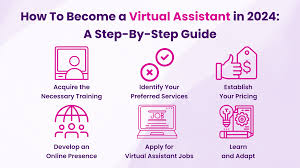
How to Become a Virtual Assistant
Follow this step-by-step roadmap to go from zero to your first paid client.
Step 1: Choose Your Services (Do not be a generalist at first)
Pick 2–3 services to offer. Example: “Email management + Calendar scheduling + Data entry.” Do not say “I can do everything.” Clients prefer specialists.
Step 2: Set Up Your Home Workspace
- A quiet corner (even a closet works).
- A decent laptop (used ThinkPad or Dell Latitude for $200–$300).
- Noise-canceling headphones (Anker Soundcore or similar, $40–$60).
- Reliable internet (at least 10 Mbps download, 5 Mbps upload).
Step 3: Create Your Brand (Free)
- Email address:
yourname@outlook.comoryourname@gmail.com(notcutiepie1999@...). - LinkedIn profile with professional photo (use a phone camera against a plain wall).
- One-page website (use Carrd or Linktree for free).
Step 4: Set Your Rates
- Beginner: $5–$12 per hour.
- Intermediate (6 months experience): $12–$20 per hour.
- Advanced (1+ year, specialized): $25–$50+ per hour.
- Start low to get testimonials, then raise rates every 3–6 months.
Step 5: Create 3 Portfolio Samples
- Sample email inbox organized with labels/filters.
- Sample social media calendar for a fake bakery.
- Sample expense tracking sheet in Excel.
Save these as PDFs or screenshots.
Step 6: Create Profiles on 2–3 Platforms
Start with Upwork and LinkedIn. Add Fiverr or OnlineJobs.ph later.
Step 7: Apply to 5–10 Jobs Every Day
Treat job hunting like a job. Send customized proposals (not copy-paste). Within 2–4 weeks, you will get your first response.
Step 8: Over-Deliver on Your First Job
Work faster than expected. Communicate clearly. Ask for a testimonial (written review) upon completion.
Step 9: Ask for Referrals
“Thank you for the opportunity. If you know anyone else who needs help with [your service], I would appreciate an introduction.”
Step 10: Raise Your Rates
After 3 successful jobs or 3 months of consistent work, message existing clients: “Starting next month, my rate will increase to $X/hour due to demand. I would love to continue working with you at this new rate.”
Tools Used by Virtual Assistants
You do not need expensive software. These free or low-cost tools are industry standards.
| Category | Tool | Cost | Purpose |
|---|---|---|---|
| Productivity | Google Workspace (Docs, Sheets, Drive) | Free | Documents, spreadsheets, cloud storage |
| Office Suite | Microsoft Office Online | Free | Word, Excel, PowerPoint (basic) |
| Communication | Slack | Free | Team chat, channels, direct messages |
| Video Calls | Zoom | Free (40-min limit on free plan) | Client meetings, training |
| Task Management | Trello | Free | Kanban boards for task tracking |
| Project Management | Asana | Free (limited) | Task assignments, deadlines |
| Time Tracking | Clockify | Free | Track hours per client |
| Password Management | Bitwarden | Free | Store client logins securely |
| Graphic Design | Canva | Free | Social media graphics, resumes |
| AI Assistant | ChatGPT | Free | Draft emails, brainstorm ideas |
| Scheduling | Calendly | Free (1 event type) | Let clients book time with you |
| Transcription | Otter.ai | Free (300 mins/month) | Transcribe client meetings |
Best Websites to Find Virtual Assistant Jobs
Do not rely on one platform. Create profiles on 3–4 of these sites and apply consistently.
| Website | Best For | Fee Structure | Difficulty |
|---|---|---|---|
| Upwork | General VA, long-term contracts | 10% fee on earnings | Medium (competitive) |
| Fiverr | Specific services (e.g., “I will organize your inbox”) | 20% fee | Low (easy to start) |
| Freelancer | Fixed-price projects, contests | 10% fee | Medium |
| PeoplePerHour | UK/European clients | 10–20% fee | Medium |
| Professional VAs, executive support | Free (no platform fee) | High (needs good profile) | |
| Indeed | Full-time remote VA jobs | Free (no platform fee) | High (needs resume) |
| Remote.co | Curated remote jobs (no scams) | Free | Medium |
| FlexJobs | High-quality, screened jobs | Subscription ($15–$50/month) | Low (but costs money) |
| OnlineJobs.ph | Long-term VAs (Philippines focused) | Free for workers | Low |
| Belay | US-based executive VAs | No fee (you are an employee) | High (strict requirements) |
Pro tip: Avoid job posts that ask you to pay money to apply or “verify your identity.” Those are scams.
Virtual Assistant Salary Expectations
Earnings vary widely based on experience, specialization, location, and client budget.
| Experience Level | Hours per Week | Monthly Earnings (USD) | Hourly Rate (USD) |
|---|---|---|---|
| Beginner (0–6 months) | 10–20 | $200–$800 | $5–$12 |
| Intermediate (6–18 months) | 20–35 | $1,000–$2,800 | $12–$20 |
| Experienced (1.5–3 years) | 30–40 | $3,000–$6,000 | $20–$35 |
| Specialized/Executive VA (3+ years) | 30–40 | $5,000–$10,000+ | $35–$60+ |
Note: VAs in North America, Australia, and Western Europe typically earn higher rates ($25–$60/hour). VAs in South Asia, Southeast Asia, and Africa often earn lower rates ($5–$15/hour) but have lower living costs.
Virtual Assistant Jobs in Pakistan
The VA industry in Pakistan has grown rapidly. English proficiency, affordable internet, and a young population make it a hub for remote work.
Average rates for Pakistani VAs:
- Beginner: PKR 300–600 per hour ($1–$2 USD)
- Intermediate: PKR 800–1,500 per hour ($3–$5 USD)
- Experienced: PKR 2,000–4,000 per hour ($7–$14 USD)
Popular platforms for Pakistani VAs:
- Upwork (many Pakistani top-rated VAs)
- Fiverr (strong presence in data entry and social media)
- OnlineJobs.ph (though focused on Philippines, Pakistanis are accepted)
- Facebook Groups (“Pakistan Virtual Assistants,” “Freelance Pakistan”)
Challenges:
- Internet outages (have a backup mobile hotspot).
- Power outages (invest in a UPS or laptop with long battery life).
- Payment withdrawal (use Payoneer, SadaPay, or Elevate Pay to receive USD).
Virtual Assistant Jobs in the UAE
The UAE (Dubai, Abu Dhabi, Sharjah) has a high demand for VAs, particularly for real estate, e-commerce, and executive support.
Average rates for UAE-based VAs:
- Beginner: AED 30–50 per hour ($8–$14)
- Intermediate: AED 60–100 per hour ($16–$27)
- Experienced: AED 120–250 per hour ($33–$68)
Where to find VA jobs in UAE:
- Dubizzle (local classifieds)
- Bayt.com (Middle East job board)
- NaukriGulf
- LinkedIn (search “Virtual Assistant Dubai”)
Special note: Many UAE companies prefer VAs who work overlapping hours (GMT+4) and speak Arabic or Hindi/Urdu in addition to English.
Virtual Assistant Jobs in Saudi Arabia
Saudi Arabia’s Vision 2030 plan is driving digital transformation, creating remote work opportunities.
Average rates for Saudi-based VAs:
- Beginner: SAR 40–70 per hour ($11–$19)
- Intermediate: SAR 80–150 per hour ($21–$40)
- Experienced: SAR 160–300 per hour ($43–$80)
Popular industries:
- Real estate (property listing management)
- E-commerce (Noon, Amazon.sa)
- Education (online tutoring coordination)
Where to find jobs:
- Haraj (local classifieds, Arabic required)
- Bayt.com (filter by “Remote”)
- LinkedIn (Arabic-language job posts)
Virtual Assistant Jobs in Canada, UK, Australia, and the USA
These English-speaking countries offer the highest rates for VAs, but competition is intense.
| Country | Average Hourly Rate (USD) | Best Platforms | Demand Areas |
|---|---|---|---|
| USA | $20–$60 | Upwork, Belay, Indeed | Executive support, real estate, healthcare |
| Canada | $18–$50 | Remote.co, FlexJobs, LinkedIn | E-commerce, administrative, social media |
| UK | $15–$45 | PeoplePerHour, Upwork, Freelancer | Administrative, content creation, bookkeeping |
| Australia | $20–$55 | Airtasker, Upwork, Freelancer | Real estate, customer support, scheduling |
Tip for non-residents: You do not need to live in these countries to work for their clients. However, you must be available during their working hours (at least partially). Use time zone converters to plan your schedule.
Freelancing vs Full-Time Virtual Assistant Jobs
You have two main employment models. Each has pros and cons.
| Factor | Freelance Virtual Assistant | Full-Time Remote VA Employee |
|---|---|---|
| Employment status | Self-employed (1099 contractor) | Employee (W-2 or equivalent) |
| Clients | Multiple | Single |
| Income stability | Variable (unpredictable) | Fixed salary |
| Benefits | None (no health insurance, paid leave) | Possible benefits (depends on country/company) |
| Taxes | You pay self-employment tax | Employer withholds taxes |
| Schedule | Flexible (choose your hours) | Fixed schedule |
| Workload | You control it | Set by employer |
| Best for | Risk-tolerant, wants variety | Prefers stability, benefits |
Recommendation: Start as a freelancer to build skills and a client base. If you find a client who offers consistent 30–40 hours per week at a good rate, consider transitioning to a full-time arrangement.
How to Create a Virtual Assistant Resume
Your resume should be one page (maximum two). Focus on skills and results, not job titles.
Resume Template:
[Your Name]
[Your Email] | [Your Phone] | [Link to LinkedIn]
[City, Country]
Professional Summary
Dedicated Virtual Assistant with [X] months of experience in [services]. Proficient in [tools]. Helped [type of clients] save [X] hours per week by [specific result].
Core Competencies
- Administrative Support (email, calendar, travel booking)
- Social Media Management (scheduling, engagement, Canva)
- Data Entry & Spreadsheets (Excel, Google Sheets)
- Customer Service (Zendesk, Gorgias, email support)
- Time Management & Communication
Portfolio / Selected Projects
- Client A (Upwork): Managed email inbox, reducing response time from 24 hours to 4 hours.
- Client B (Freelancer): Created 30 social media posts in Canva, increasing engagement by 40%.
- Sample Project: [Link to Google Drive folder with samples]
Tools & Software
Google Workspace, Microsoft Office, Slack, Trello, Canva, Zoom, Calendly, ChatGPT
Certifications (Free)
- Google Project Management Certificate (Coursera – free with financial aid)
- Virtual Assistant Foundations (LinkedIn Learning – 1-month free trial)
Education
[Your Degree or High School Diploma], [Year]
Languages
English (Fluent), [Other language]
How to Write a Winning VA Proposal
Your proposal is the most important factor in getting hired. A generic “I am interested in this job” will be ignored.
Proposal structure (keep under 250 words):
Subject line: “I can help with [specific task] – [Your Name]”
Salutation: Hi [Client Name], (if name is not shown, use “Hi there,”)
Opening: “I saw you need help with [restate the problem]. I have [X] months of experience doing exactly this.”
Your solution (2–3 bullet points):
- “I will organize your inbox using labels and filters, ensuring you never miss an important email.”
- “I will schedule all meetings via Calendly, sending reminders 24 hours in advance.”
- “I will create a weekly report every Friday summarizing completed tasks.”
Proof (social proof): “Recently, I helped [similar client] reduce their email backlog from 500 to 50 messages in one week.”
Call to action: “I am available for a 15-minute chat this Thursday or Friday. Let me know what time works for you.”
Closing: Best regards, [Your Name]
Mistakes to avoid:
- Writing a 1,000-word essay. Clients are busy.
- Listing irrelevant skills (“I love hiking”).
- Asking “What is the budget?” before proving your value.
- Copy-pasting the same proposal 100 times (clients can tell).
Virtual Assistant Interview Questions and Answers
Clients often conduct a quick video or chat interview before hiring. Prepare for these common questions.
- Why do you want to be a Virtual Assistant?
“I enjoy helping businesses run smoothly. I am organized, detail-oriented, and love learning new tools. Remote work allows me to focus deeply without office distractions.” - What software are you most comfortable with?
“I am proficient in Google Workspace (Docs, Sheets, Drive), Slack, Trello, and Canva. I am also a quick learner and can master new tools within a few days.” - How do you handle multiple deadlines?
“I use Trello to visualize all tasks. I prioritize by urgency (client deadlines first) and block time on my calendar for deep-focus work. I also communicate with clients if I foresee a delay.” - What hours are you available?
“I am available [X] hours per week, typically between [start time] and [end time] [time zone]. I can also adjust to [client’s time zone] for [Y] hours per week.” - Have you worked with clients in my industry before?
“I have not worked specifically in [industry], but I have done [related task] for [other industry]. The principles of [email management / scheduling / data entry] are the same. I am excited to learn your industry’s nuances.” - How do you ensure data security?
“I use a password manager (Bitwarden) for client logins. I never store passwords in plain text. I enable two-factor authentication on all accounts. I work on a personal, secure laptop with updated antivirus software.” - What is your typing speed?
“My typing speed is [X] WPM with [Y]% accuracy.” (If you do not know, take a free test at 10fastfingers.com). - How do you handle a mistake you made?
“I take ownership immediately. I inform the client, apologize without excuses, and propose a solution. For example, if I double-booked a meeting, I would reschedule the affected attendee and adjust my process to prevent recurrence.” - Why should we hire you instead of a cheaper VA?
“I focus on quality and reliability. You will not need to double-check my work or chase me for updates. I deliver on time, every time. The cost difference is small compared to the time you save.” - Do you have experience with [specific tool]?
“I have not used [tool] yet, but I have watched tutorial videos and I am confident I can learn it within [X] days. I am a fast learner.” - How do you handle confidential information?
“I treat client information as if it were my own. I do not share details with anyone. I use encrypted communication channels (Slack, ProtonMail) when available. I sign NDAs without hesitation.” - What is your preferred communication style?
“I am flexible. I can check in daily via Slack, have a weekly Zoom call, or communicate asynchronously via email. I adapt to the client’s preference.” - How do you stay motivated when working alone?
“I thrive on autonomy. I set daily goals, use a time tracker (Clockify) to stay accountable, and take short breaks to recharge. I also participate in online VA communities for support.” - What are your long-term career goals?
“I plan to specialize further in [your chosen niche, e.g., real estate VA] and eventually lead a small team of VAs. I am looking for a long-term client relationship where I can grow with the business.” - Do you have any questions for us?
“Yes. What are the top 3 priorities you need help with in the first 30 days? What is your preferred communication frequency? Are there any tools you expect me to learn before starting?”
Advantages of Virtual Assistant Careers
- Location independence: Work from home, a beach, or a mountain cabin.
- Low barrier to entry: No degree, no certification, no expensive equipment.
- Scalable income: Raise your rates as you gain experience. Add more clients.
- Diverse work: One day you are scheduling podcasts; the next, you are researching competitors.
- Learn transferable skills: Project management, client communication, time tracking—these are valuable for any future career.
- Environmentally friendly: No commuting reduces your carbon footprint.
Challenges of Remote Work
Remote work is not all positive. Be aware of these challenges and plan for them.
| Challenge | Solution |
|---|---|
| Loneliness / isolation | Join VA Facebook groups, coworking Zoom rooms, or work from a library once a week. |
| Distractions at home | Set clear boundaries. Use noise-canceling headphones. Close your bedroom door. |
| Unstable income | Save a 3-month emergency fund. Work with 3–4 clients simultaneously. |
| No benefits (health insurance, paid leave) | Budget for private insurance. Charge higher rates to compensate. |
| Time zone differences | Use World Time Buddy. Clearly state your working hours in your contract. |
| Difficult clients | Learn to say no. Fire clients who do not respect your time. |
| No separation between work and home | Have a designated workspace. Shut down your computer at the same time every day. |
Common Mistakes New Virtual Assistants Should Avoid
- Undercharging: Do not work for $2/hour. You will burn out and resent the work.
- Not having a contract: Even a simple one-page agreement protects both parties.
- Saying “yes” to every task: You are a VA, not a mind reader. Clarify expectations upfront.
- Working without tracking time: Use Clockify or Toggl. Bill for every minute.
- Not asking for testimonials: A written review is gold for landing future clients.
- Ignoring self-education: Spend 2 hours per week learning a new tool or skill.
- Ghosting clients: If you are overwhelmed, communicate. Disappearing destroys your reputation.
Tips to Get Your First Virtual Assistant Client
- Start in your network. Ask former employers, family friends, or local small business owners if they need help with email or social media.
- Offer a free trial. “I will work 5 hours for free. If you like my work, we can continue at $X/hour.”
- Target new business owners. They are overwhelmed and need help but have small budgets. Search “just launched” or “new store” on LinkedIn.
- Create a “How I Can Help You” PDF. List 10 tasks you can do. Send it to 50 small business owners via LinkedIn or email.
- Use the “Craigslist method.” Post your services in the “Gigs” section of your local Craigslist. Offer in-person or remote assistance.
- Join Facebook Groups for entrepreneurs. Do not spam. Answer questions helpfully, then mention “I am a VA, DM me if you need help.”
- Upwork strategy: Apply to jobs posted within the last 15 minutes. Be among the first 5 proposals.
Career Growth Opportunities for Virtual Assistants
VA work is not a dead-end job. You can grow in several directions.
- Specialized VA: Become an expert in real estate, legal, medical, or e-commerce VA work. Charge higher rates.
- VA Team Lead: Hire other VAs to work under you. Take a percentage of their earnings (e.g., you find clients, they do the work).
- Agency Owner: Start a remote staffing agency. Match VAs with clients. Charge a monthly retainer.